Climate Change Manifestations: December 2025 Report
🌐 Connective Narrative: Three Faces of the Same Crisis
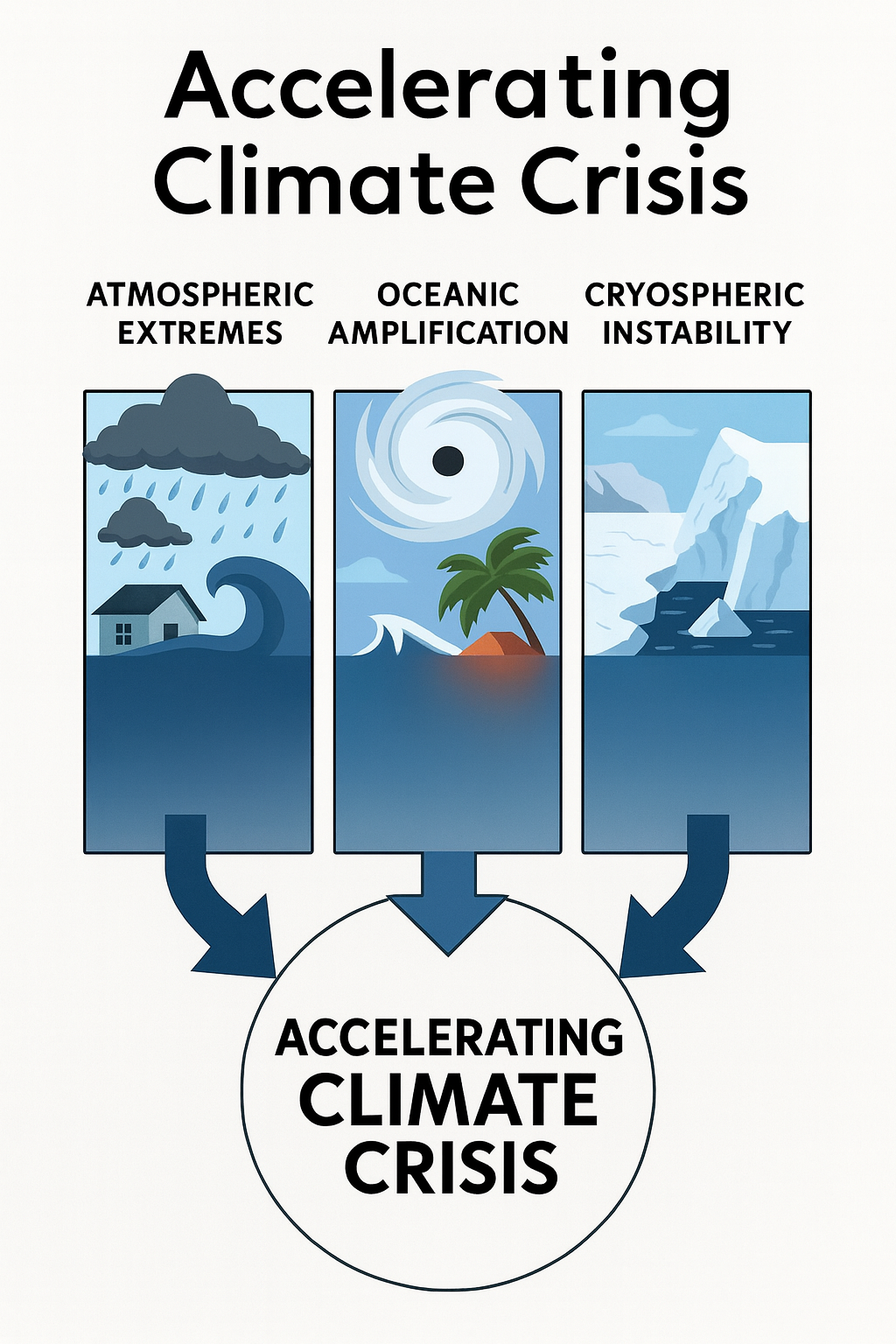
December arrives with a chorus of signals that climate change is accelerating across almost every domain of Earth’s system. What might appear at first glance to be isolated disasters — catastrophic floods in Washington State, deadly cyclones sweeping across Asia, and seismic tremors beneath Antarctica’s Thwaites Glacier — are in fact interconnected manifestations of the same crisis. They are threads of a single tapestry, woven together by the physics of a warming planet.
Atmospheric Extremes (Pacific Northwest)
Warmer air holds more moisture, and shifting jet streams stall storms in place. The Pacific Northwest experienced this reality as atmospheric rivers delivered historic rainfall, overwhelming rivers, infrastructure, and communities.
Oceanic Amplification (Asia)
Decades of accumulated heat now fuel cyclones with unprecedented energy. Across Malaysia, Thailand, Indonesia, and Sri Lanka, storms transformed into climate‑charged catastrophes. Floods and landslides displaced thousands, and the human toll was measured not only in fatalities but in the erosion of livelihoods and stability.
Cryospheric Instability (Thwaites Glacier)
At the frozen edge of the planet, the cryosphere is destabilizing. Seismic activity at Thwaites Glacier signals fractures deep within the ice, a warning that collapse could unleash meters of sea level rise worldwide. What happens in Antarctica will not remain there; it will ripple outward, reshaping coastlines and communities across the globe.
Together, these domains reveal a systemic pattern: the atmosphere is wetter and more volatile, the oceans are hotter and more energetic, and the cryosphere is weakening under relentless heat. Each feeds the other. Warmer oceans fuel stronger storms; stronger storms erode ice; collapsing ice raises seas that magnify flood risks. The crisis is not siloed — it is interconnected.
This triad of events is our Opening Signal for December: climate change is no longer a distant abstraction. It is atmospheric, oceanic, and cryospheric all at once, reshaping the systems that sustain life. Recognizing these links is the first step toward designing responses that are as interconnected as the crisis itself.
🌍 Beyond the Triad: A Global Cascade
- Sri Lanka and Indonesia Floods (late November 2025): Cyclone Ditwah in Sri Lanka and Cyclone Senyar in Indonesia intensified rainfall, triggering floods and landslides that killed hundreds and displaced thousands.
- Wildfires in New Mexico (early December 2025): Prolonged dry conditions fueled destructive fires, destroying homes and infrastructure.
- Flooding in Brazil (December 2025): Torrential rains displaced communities and caused significant casualties.
- Heatwaves in South and Southeast Asia (December 2025): Record temperatures triggered health crises, disrupted schooling, and strained energy systems.
- Drought and Heat Wave in Southern and Eastern USA (December 2025): Rising temperatures and reduced water availability stressed agriculture and water supplies.
📊 Global Context
| Event | Location | Date | Impact |
|---|---|---|---|
| Cyclone Remal | Bangladesh, India | Late May 2024 | Wind speeds up to 140 km/h; over 800,000 evacuated in Bangladesh. |
| Flooding | Kenya | Early May 2024 | Over 225 deaths; 212,630 displaced due to heavy rainfall. |
| Extended Drought | Central America | Ongoing | Six years of drought affecting Guatemala, Honduras, El Salvador, and Nicaragua; 3.5 million in need of aid. |
✨ Framing the Report
December’s record floods, cyclones, seismic tremors, wildfires, and heatwaves are not isolated disasters. They are manifestations of a systemic unraveling, intensified by human‑caused climate change. Each event is a signal, and together they form a chorus: the accelerating crisis is reshaping the atmosphere, oceans, and cryosphere, while cascading into human systems everywhere.
🌪️ Atmospheric Extremes: Pacific Northwest Floods
Looking Ahead
Without systemic adaptation — from resilient infrastructure to proactive disaster planning — communities across the Pacific Northwest and beyond will face escalating risks in the years ahead. As climate change accelerates, these measures are likely to prove insufficient to handle the developing crisis, making greenhouse gas drawdowns and humanity’s immediate pivot to clean renewables the only viable long‑term path for our continued success.
🧊 Cryospheric Instability: Thwaites Glacier
At the frozen edge of Antarctica, December 2025 brought a deeply concerning signal: seismic activity recorded beneath the Thwaites Glacier. Often called the “Doomsday Glacier,” Thwaites is already retreating rapidly as warm ocean currents erode its base. The new tremors suggest fractures deep within the ice, a warning that collapse may be accelerating.
The cryosphere — Earth’s frozen domain — is destabilizing under relentless heat. Warming oceans undermine ice shelves, thinning them from below, while atmospheric warming weakens them from above. Seismic signals at Thwaites reveal that stresses are building inside the glacier itself, pointing to structural failure that could unleash meters of sea level rise worldwide. But it is not land that is experiencing the quakes — it is ice, and ice responds to quakes much differently than rock. These icequakes mark fractures and slips within the glacier, underscoring that destabilization is advancing at a rapid pace and stability is now in question.
In recent years, scientists have recorded hundreds of seismic events beneath Thwaites, triggered by fracturing and sudden slips as melting accelerates. These icequakes reveal that the glacier’s retreat is advancing at a rapid pace, to the point where its stability is now in question.
Key Impacts
- Global sea level rise: Thwaites alone holds enough ice to raise seas by up to 10 feet if it collapses.
- Coastal vulnerability: Cities from Miami to Mumbai face existential risks as seas rise and storm surges intensify.
- Ecological disruption: Loss of ice alters ocean circulation, threatening marine ecosystems and fisheries.
- Geopolitical stakes: Mass displacement and infrastructure loss could destabilize economies and societies worldwide.
Climate Link
The seismic activity at Thwaites is not random. It is a manifestation of climate‑driven destabilization: warmer oceans eroding grounding lines, fractures propagating through ice shelves, and stresses accumulating until collapse becomes inevitable. Each quake signals fractures deep within the glacier, revealing that melting is advancing at a rapid pace. This is the cryosphere’s response to human‑caused warming, and its consequences will be global.
Looking Ahead
Without rapid greenhouse gas drawdowns and intentional stabilization and refreeze, the cryosphere will continue to weaken. Engineering partial interventions may buy time, but they cannot substitute for systemic climate action. Humanity’s immediate pivot to clean renewables is the only viable long‑term path to slow ocean warming, stabilize ice sheets, and preserve coastal communities. The seismic signals at Thwaites are not just data points — they are alarms, reminding us that the window for repair is narrowing.
🌍 Beyond the Triad: A Global Cascade
While the floods in Washington State, the cyclones across Asia, and the seismic alarms at Thwaites Glacier represent the most profound signals of December’s accelerating crisis, they were not the only events to devastate communities. The past 30 days have been marked by a cascade of climate‑charged disasters across multiple continents.
- Sri Lanka and Indonesia Floods (late November 2025): Cyclone Ditwah in Sri Lanka and Cyclone Senyar in Indonesia intensified rainfall, triggering floods and landslides. Hundreds of lives were lost, and thousands were displaced, underscoring how warmer sea surface temperatures amplify tropical storms.
- Wildfires in New Mexico (early December 2025): Prolonged drought and dry conditions fueled destructive fires, consuming homes and infrastructure. Communities already stressed by water scarcity faced new waves of displacement.
- Flooding in Brazil (December 2025): Torrential rains inundated cities and rural areas alike, causing significant casualties and widespread displacement. The floods highlighted vulnerabilities in both urban planning and rural resilience.
- Heatwaves in South and Southeast Asia (December 2025): Record‑breaking temperatures strained health systems, disrupted schooling, and pushed energy grids to their limits. The heatwaves revealed how climate change magnifies risks beyond storms and floods, threatening human health directly.
- Drought and Heat Wave in Southern and Eastern USA (December 2025): Rising temperatures and reduced water availability stressed agriculture and water supplies, eroding food security and amplifying economic risks.
📊 Global Context
Placed against the backdrop of recent years, December’s manifestations are part of a longer chain of escalating extremes:
- Cyclone Remal (Bangladesh, India, May 2024): Winds up to 140 km/h forced the evacuation of over 800,000 people.
- Flooding in Kenya (May 2024): Heavy rainfall displaced more than 200,000 people and caused over 225 deaths.
- Extended Drought in Central America (ongoing): Six years of water scarcity continue to affect millions, eroding food security and stability.
✨ Framing the Cascade
Taken together, these events reveal that climate change is not confined to one geography or one hazard. It is a global cascade, intensifying floods, fires, droughts, and heatwaves simultaneously. Each manifestation is a signal, and together they form a chorus: the accelerating crisis is reshaping the atmosphere, oceans, and cryosphere, while cascading into human systems everywhere.
🔔 Conclusion: The Window for Repair is Narrowing
December 2025 has shown us that climate change continues to no longer be a distant abstraction. It is atmospheric, oceanic, and cryospheric all at once — reshaping the systems that sustain life. The floods in Washington State, the cyclones across Asia, and the seismic alarms at Thwaites Glacier are not isolated disasters; they are interconnected manifestations of a warming planet.
Beyond this triad, wildfires in New Mexico, floods in Brazil, heatwaves across Asia, and droughts in the United States remind us that the crisis is global, cascading across geographies and hazards simultaneously. Each event is a signal, and together they form a chorus: the accelerating crisis is intensifying everywhere, in every domain.
Adaptation — stronger infrastructure, disaster planning, and resilience measures — is necessary, but it will not be enough. Engineering interventions may buy time, but they cannot substitute for systemic climate action. Only rapid greenhouse gas drawdowns, intentional stabilization and refreeze of the cryosphere, permafrost stabilization and complete refreeze, Amazon Rainforest restoration and repair, full restoration of global coral reefs, humanity’s immediate pivot to clean renewables, and more can slow ocean warming, stabilize ice sheets, preserve coastal communities, and ultimately heal our climate systems.
The seismic signals at Thwaites are not just data points; they are alarms. They remind us that the window for repair is narrowing. The choice before us is stark: delay and face collapse, or act decisively and reclaim a path toward survival and stability.
We are running out of time. Our time to take decisive action is now.