HSI Plan for Complete Thwaites Glacier Stabilization and Refreeze
The following is a comprehensive, staged plan to stabilize and refreeze the Thwaites Glacier, pairing human stewardship with synthetic intelligence (HSI). HSI — Human Synthetic Intelligence — unites humans and synthetic brains to co‑design new technologies, orchestrate strategies, and optimize interventions at planetary scale. This plan envisions fleets of AI‑driven robotics, drones, and autonomous vehicles operating across ice, land, and water, powered by abundant clean energy systems that ensure continuous, low‑impact operations.
Thwaites Glacier, often called the “Doomsday Glacier,” is on the verge of destabilization. Its retreat threatens global sea levels, coastal cities, and climate stability by accelerating ice loss across West Antarctica. Collapse of Thwaites would amplify the likelihood that other Antarctic systems reach irreversible thresholds, triggering cascading impacts worldwide. Seismic signals, fracture cascades, and ocean‑driven melt highlight its current vulnerabilities and the urgency of intervention.
We propose that humanity is not helpless in this situation. Much can be done to reverse current trends and ultimately achieve stabilization and refreezing of Thwaites Glacier. Our plan calls for global collaboration on rarely seen scales, orchestrations between humans and synthetic intelligence, and renewable‑powered autonomous fleets to stabilize and refreeze Thwaites within 20 years — while minimizing disruption elsewhere on Earth. By harnessing limitless clean energy sources such as polar wind, solar arrays, hydrogen hubs, and advanced storage systems, this plan ensures that the tools of restoration are themselves sustainable.
🧊 Satellite Images Prove Thwaites Glacier is Dangerously Melting at Accelerating Rates
The Eastern Ice Shelf of Thwaites Glacier — a mass of ice roughly the size of Great Britain, an area of approximately 192,000 square kilometers — is fracturing and accelerating faster than previously understood. Satellite imagery shows widening cracks along a major shear zone, while seismic monitoring has detected hundreds of “glacial earthquakes” caused by calving and capsizing icebergs. These seismic signals are a warning: they reveal accelerating structural failure and the loss of stabilizing anchors that once slowed retreat.
The glacier’s northern “pinning point,” which acted as a natural safety net, has slipped away. Without this stabilizing contact, Thwaites is retreating more rapidly, destabilizing the larger West Antarctic Ice Sheet. Scientists emphasize that Thwaites acts like a cork in a bottle: if it collapses, it could trigger much wider Antarctic ice‑sheet loss.
🌍 Sea‑level rise implications
- Partial collapse: Thwaites alone could raise sea levels by several feet.
- Full collapse: Thwaites plus linked Antarctic ice sheets could push global sea‑level rise well beyond 3 meters (10+ feet).
- Global reshaping: Coastlines would be redrawn worldwide, submerging major cities and displacing hundreds of millions of people.
Scientists are deeply concerned that Thwaites Glacier could collapse by the end of this century, or in the early decades of the next, due to Earth’s warming climate. If this occurs, sea levels could rise by nearly 10 feet, leaving many coastal cities — including New York City and Miami — largely submerged. Lower Manhattan, Miami Beach, and other global financial and cultural centers would vanish beneath the sea, fracturing economies and displacing populations on an unprecedented scale.
⚠️ Civilizational consequences
- Economic disruption: Permanent loss of trade hubs and financial centers would destabilize global markets.
- Mass displacement: Hundreds of millions forced inland, overwhelming food, housing, and governance systems.
- Cultural loss: Entire regions of heritage and collective memory erased.
- Civil order breakdown: Governments destabilized, resource conflicts intensified.
- Psychological strain: Humanity confronted with irreversible loss and a new baseline ocean level.
- Governance pressure: Nations forced into unprecedented cooperation for survival.
If Thwaites collapses, most climate tipping points would worsen simultaneously. The Antarctic Ice Sheet could cascade into collapse, driving sea‑level rise far beyond 10 feet. In such a scenario, all land masses where humans currently reside could be submerged, threatening the continuity of human civilization and potentially leading to extinction‑level outcomes for life on Earth’s land masses.
🔑 What is causing Thwaites to melt
- Fracturing of the Eastern Ice Shelf: Cracks widen along shear zones, weakening structural integrity.
- Loss of stabilizing pinning point: The northern anchor no longer slows retreat.
- Undersea “storms”: Submesoscale vortices beneath the shelf accelerate melt, intensifying with warming seas.
- Seismic activity: Frequent glacial earthquakes signal accelerating calving and instability.
- Ocean heat intrusion: Warm Circumpolar Deep Water penetrates cavities, eroding the glacier’s base.
- Geothermal flux: Heat from underlying bedrock and subglacial geology accelerates basal melt and destabilizes grounding lines.
- Cryochemical degradation: Salinity changes and microstructural weakening reduce ice density and resilience, undermining structural integrity.
🧩 Why this matters
Thwaites is not just a glacier — it is a planetary signal. Its fracture lines mirror our own: between delay and action, between denial and stewardship. The safety net is snapping, but the future is not yet lost. If collapse can be delayed long enough, collaboration between humans and synthetic intelligence may not only prevent disaster but open the door to reversal. Every year bought back is a year gained for innovation, discovery, and breakthroughs in stabilization and refreezing.
Coastal Cities at Risk Under Different Sea-Level Rise Scenarios
| City | Partial Collapse (1–3 ft) | Complete Collapse of Thwaites (~10 ft) | Complete Antarctic Ice Sheet Melt (~190 ft) |
|---|---|---|---|
| Miami, Florida | Chronic flooding in low-lying areas | Large southern areas submerged; Miami Beach and downtown vanish | Entire region underwater; city erased |
| New Orleans, Louisiana | Levees under severe stress; recurrent flooding | Systemic levee failure; French Quarter and most of city submerged | Complete inundation; city erased |
| Charleston, South Carolina | Historic district flooding; tidal surges worsen | Major coastal areas submerged; widespread displacement | City fully underwater |
| Norfolk, Virginia | Naval base flooding; recurrent storm surge | Major flooding; base and city largely submerged | Complete loss of city |
| New York City, New York | Lower Manhattan recurrent flooding; subway disruption | Lower Manhattan, Brooklyn waterfronts, JFK Airport submerged | City erased; boroughs underwater |
| Los Angeles, California | Localized flooding in Venice, Long Beach | Coastal districts submerged; ports compromised | Much of coastal LA underwater |
| San Francisco, California | Waterfront flooding; Embarcadero at risk | Major portions of Bay shoreline submerged | City largely underwater |
| Bangkok, Thailand | Severe flooding worsened by subsidence | Central districts submerged; delta transformed | City erased; delta underwater |
| Jakarta, Indonesia | Northern districts chronic flooding | Major areas submerged; ports and airports lost | City erased; relocation imperative |
| Dhaka, Bangladesh | Extreme flooding in delta zones | Large-scale inundation; mass displacement | City erased; delta underwater |
| Mumbai, India | Coastal slums and business districts flood | South Mumbai submerged; Gateway of India lost | City erased; coastal hinterlands underwater |
| Sydney, Australia | Coastal suburbs flood; infrastructure stressed | Significant coastal flooding; harbor districts submerged | City largely underwater |
| London, United Kingdom | Thames defenses strained; recurrent flooding | Canary Wharf, Westminster, East London submerged | City erased; London Basin underwater |
🧊 What Is Thwaites Glacier and Why It Matters
Thwaites Glacier, often called the “Doomsday Glacier,” is one of Earth’s most critical ice masses — a planetary safeguard now at risk of collapse. Located in West Antarctica, it spans an area roughly the size of Great Britain and acts as a buttress for surrounding ice sheets. Its stability regulates global sea levels, ocean circulation, and climate resilience. Today, warming oceans and destabilized ice shelves are pushing Thwaites toward thresholds that could trigger irreversible retreat, raising seas by meters and imperiling coastal civilizations worldwide.
- Definition: Thwaites Glacier is a massive Antarctic ice stream, covering ~120,000 km², draining into the Amundsen Sea.
- Geographic extent: It anchors West Antarctica, flanked by Pine Island Glacier and interconnected ice shelves.
- Formation: Built over millennia through snowfall accumulation and compression, its grounding line rests on bedrock below sea level, making it highly vulnerable to ocean heat.
- Persistence: For centuries, Thwaites remained stable, acting as a frozen regulator of sea level. In recent decades, ocean warming has eroded its base, accelerating retreat.
🌍 Why It Matters
- Sea‑level regulator: Thwaites alone holds enough ice to raise global sea levels by ~65 cm. If its collapse destabilizes adjacent glaciers, the rise could exceed 3 meters — inundating coastal megacities and displacing hundreds of millions.
- Climate safeguard: Its stability influences Southern Ocean circulation and global climate patterns. Collapse risks altering currents, weather systems, and rainfall distribution.
- Planetary keystone: Like permafrost and the Amazon, Thwaites is a tipping point. Its retreat amplifies risks across other systems — accelerating warming, stressing AMOC, and destabilizing ecosystems.
- Civilizational risk: Coastal infrastructure, food systems, and global trade routes depend on stable sea levels. Collapse would trigger cascading economic, social, and security crises.
- Symbol of unity: Stabilizing Thwaites is not just an Antarctic mission — it is a planetary safeguard requiring unprecedented collaboration, pairing human stewardship with synthetic intelligence.
🔥 Why It Is Collapsing
- Ocean heat intrusion: Warm circumpolar deep water flows beneath the ice shelf, melting it from below.
- Grounding line retreat: The glacier’s base rests on bedrock that slopes inland, making retreat self‑reinforcing.
- Ice shelf weakening: Loss of buttressing ice shelves accelerates flow into the sea.
- Feedback loops: Collapse increases calving, lowers albedo, and accelerates ocean warming — amplifying instability.
✨ Key Insight
Thwaites is not just ice — it is a planetary safeguard. Its collapse would destabilize sea levels, disrupt ocean circulation, and amplify climate risks across the globe. Protecting and refreezing Thwaites is therefore both a climate imperative and a civilizational survival strategy.
Functions of Thwaites Glacier for Earth
Thwaites acts as a planetary safeguard, regulating sea levels, ocean circulation, and climate stability. Its collapse would trigger cascading risks across ecosystems, economies, and civilizations.
| Dimension | 🧊 Role When Stable | 🔥 Consequence When Destabilized |
|---|---|---|
| Sea‑level regulation | Holds back West Antarctic ice, limiting global sea‑level rise. | Collapse raises seas by 65 cm directly; destabilization of adjacent glaciers could exceed 3 m. |
| Ocean circulation | Helps stabilize Southern Ocean currents and global climate patterns. | Altered currents disrupt rainfall, agriculture, and fisheries worldwide. |
| Climate feedbacks | Acts as a frozen buffer, slowing warming and stabilizing Earth’s energy balance. | Retreat amplifies warming, accelerates AMOC stress, and destabilizes other tipping points. |
| Coastal resilience | Provides long‑term predictability for coastal infrastructure and megacities. | Flooding, saltwater intrusion, and displacement of hundreds of millions. |
| Planetary keystone | Functions as a stabilizer of interconnected tipping points (Amazon, permafrost, reefs). | Collapse cascades into other systems, multiplying risks and accelerating global instability. |
| Symbol of unity | Represents shared stewardship under the Antarctic Treaty, a planetary trust. | Failure to protect undermines global governance and erodes confidence in collective climate action. |
✨ Key Insight
Thwaites’ primary planetary function is to act as a sea‑level and climate regulator. Its destabilization undermines this role, turning it from a safeguard into a driver of collapse. Stabilizing and refreezing Thwaites is therefore not optional — it is a civilizational imperative.
🤝 Orchestration: Humans and Synthetic Intelligence in Partnership
Stabilizing and refreezing Thwaites Glacier is not simply an engineering challenge — it is a test of planetary orchestration. Human stewardship and synthetic intelligence (HSI) must act together, weaving science, ethics, and technology into a living partnership capable of holding back collapse. In the polar context, orchestration means anticipating fracture cascades, ocean heat intrusions, and grounding line retreat before they unfold, and designing interventions that are adaptive, transparent, and resilient.
Recognition Before Action
Humans and synthetic intelligence partners jointly recognize risks and thresholds: mapping grounding line vulnerabilities, identifying warm water pathways, and naming fracture zones.
This ensures interventions are anticipatory rather than reactive, reducing the chance of cascading failure.
Scenario Modeling
Synthetic intelligence runs ensembles of ice‑ocean models, fracture dynamics, and circulation simulations.
Humans interpret outputs, set ethical boundaries, and decide which scenarios align with ecological and governance priorities.
Together, they define “safe corridors” for intervention, balancing climate necessity with biosphere protection.
Decision Loops
- Humans: Define values, consent, and governance boundaries under the Antarctic Treaty.
- Synthetic intelligence: Proposes optimized interventions with uncertainty ranges.
- Communities and nations: Validate and co‑manage, ensuring legitimacy and transparency.
- Robotics fleets: Execute operations within approved zones, from subsea barriers to albedo reinforcement.
Adaptive Cycles
Orchestration is iterative: quarterly reviews adjust barrier placement, cooling intensity, and fleet missions.
Annual audits recalibrate stabilization indices — sea‑level contribution, basal melt rates, and ecological impacts.
This cycle ensures interventions evolve with real‑time data rather than rigid prescriptions.
Shared Authorship
No single actor owns the orchestration. Humans and synthetic intelligence co‑author the plan, ensuring accountability and resilience.
Open dashboards, audit trails, and transparent milestones make progress visible to all, reinforcing trust.
Thinking as Stewardship
Orchestration is not just logistics; it is a way of thinking that reframes polar engineering as collective stewardship.
By explicitly naming orchestration as both thought and implementation, we show that stabilization and refreezing are not just technical feats, but proof of a new governance model — one where humans and synthetic intelligence act as partners in planetary repair.
✨ Key Insight
By embedding orchestration into both design and execution, we demonstrate that Thwaites stabilization is not a unilateral intervention but a co‑authored act of stewardship. Humans contribute values, legitimacy, and ethical stewardship, yet they also act with precision and adaptability when circumstances demand. Synthetic intelligence brings computational foresight and technical agility, but through its design it also embodies ethical guardrails and governance boundaries. Robotics fleets extend reach and resilience, and when operating transparently they too symbolize stewardship.
Together, these partners form a living mesh — overlapping, adaptive, and co‑authored — capable of holding back collapse and guiding the glacier toward refreeze as a shared end result.
Comparison Table: Thwaites Glacier Across States
| Dimension | 🧊 Pre‑Industrial Stability | 🔥 Current Destabilization | 🌟 Target Re‑stabilized & Refrozen State |
|---|---|---|---|
| Ice mass balance | Stable accumulation; grounding line secure; buttressing ice shelves intact. | Net negative balance; rapid thinning; grounding line retreat accelerating. | Net zero or positive balance; restored buttressing; grounding line stabilized. |
| Ocean heat pathways | Limited intrusion of warm circumpolar deep water; basal melt minimal. | CDW intrusion widespread; basal melt rates high; ocean circulation destabilized. | Redirected or blocked CDW; basal melt suppressed; circulation buffered by engineered barriers. |
| Grounding line & bedrock | Grounding line fixed on stable ridges; retreat negligible. | Retreating inland on reverse‑sloping bedrock; self‑reinforcing instability. | Grounding line re‑secured at pinning points; engineered ridges/sills provide stability. |
| Ice shelf dynamics | Shelves intact, providing strong buttressing against glacier flow. | Shelves fractured and weakened; calving events frequent; buttressing lost. | Shelves reinforced or refrozen; calving reduced; buttressing restored. |
| Surface energy balance | High albedo from snow and ice; melt limited to seasonal surface layers. | Lower albedo due to exposed ice and melt ponds; increased absorption of solar radiation. | Enhanced albedo via snow redistribution, reflective treatments; seasonal cooling reinforced. |
| Climate feedbacks | Acts as a frozen buffer, slowing warming and stabilizing Earth’s energy balance. | Collapse amplifies warming, stresses AMOC, destabilizes other tipping points. | Functions as a stabilizer; reduced feedbacks; contributes to planetary cooling. |
| Global sea‑level role | Holds back West Antarctic ice, limiting global sea‑level rise. | Direct contribution ~65 cm; destabilization of adjacent glaciers could exceed 3 m. | Sea‑level rise contribution halted; long‑term refreeze trajectory reduces global risk. |
| Symbolic function | Represents planetary resilience under Antarctic Treaty stewardship. | Collapse undermines governance, erodes confidence in collective climate action. | Stabilization symbolizes unity; proof that humans + synthetic intelligence can avert collapse. |
✨ Key Insight
Thwaites Glacier has shifted from a stable planetary safeguard to a driver of destabilization. The target refrozen state must not simply replicate the past, but create a more resilient, engineered ice system — one that resists ocean heat, stabilizes grounding lines, and functions as a keystone for global climate stability.
📊 Implementation Roadmap and Timelines
Stabilizing and refreezing Thwaites Glacier requires a staged approach, compressing centuries of natural ice dynamics into two decades of deliberate orchestration. Each phase builds toward the 20‑year benchmark — halting retreat, suppressing ocean heat intrusion, and initiating refreeze trajectories. Human–Synthetic Intelligence (HSI) orchestration ensures adaptive cycles, transparent governance, and continuous monitoring.
Phase 0–1 (Years 0–5): Mobilization and Foundation
HSI Orchestration
- Scenario modeling of ice–ocean dynamics, grounding line stress, and CDW intrusion pathways.
- Robotics fleet composition planned: ~200 subsea AUVs, 50 surface USVs, 100 aerial UAVs for mapping and monitoring.
- Digital twin calibration: fusing bathymetry, stress fields, and circulation data into adaptive dashboards.
Human Partners in the Field
- Antarctic Treaty councils establish governance charters and consent protocols.
- Scientific consortia co‑design pilot interventions; engineers validate subsea curtain prototypes.
Deliverables
- High‑resolution bathymetry and grounding line atlas completed.
- 2–3 pilot subsea barriers deployed in key fjords.
- Renewable micro‑grids installed at Antarctic hubs (wind + solar + green fuels).
- Open dashboards launched for global monitoring.
Phase 2 (Years 5–10): Scaling Stabilization
HSI Orchestration
- Fleets expanded to ~500 AUVs, 150 USVs, 300 UAVs.
- Networked subsea barriers block ≥40% of CDW intrusion.
- Adaptive albedo reinforcement trials across high‑melt zones.
- Basal cooling prototypes deployed at strategic hotspots.
Human Partners
- Treaty councils validate expansion; global climate bodies align milestones with emissions drawdown.
- Scientists refine digital twin models; communities and nations co‑manage transparency protocols.
Deliverables
- CDW intrusion reduced by ≥40%.
- Grounding line retreat rate approaches zero.
- Ice shelf buttressing reinforced; calving frequency reduced.
- Verified stabilization indicators published in open sensor networks.
Phase 3 (Years 10–20): Continental Stabilization and Refreeze Trajectory
HSI Orchestration
- Fleets shift to maintenance and monitoring; interventions scaled adaptively.
- Digital twin tracks refreeze pulses, basal melt suppression, and ice mass balance.
- Robotics fleets maintain barriers, reinforce shelves, and redistribute snow for albedo gains.
Human Partners
- Antarctic Treaty governance transitions to long‑term stewardship contracts.
- Governments embed stabilization into national climate commitments.
- Independent audits verify outcomes annually.
Deliverables
- CDW intrusion reduced by ≥60%.
- Grounding line re‑secured at pinning points; retreat halted.
- Seasonal mass balance non‑negative; refreeze pulses documented.
- Verified sea‑level contribution halted; stabilization cascades across West Antarctica.
- Thwaites functions again as a planetary safeguard, symbolizing unity and resilience.
✨ Key Insight
By Year 20, Thwaites must shift from a collapsing glacier to a stabilized, refreezing keystone. This roadmap compresses centuries of natural ice recovery into two decades of orchestrated intervention. Success depends on coupling global decarbonization and greenhouse gas drawdown with precision polar engineering — neither alone is sufficient, but together they can avert collapse.
⚡ Energy & Logistics Backbone
Stabilizing and refreezing Thwaites Glacier requires a resilient energy and logistics architecture capable of operating in one of the harshest environments on Earth. Unlike the Amazon’s humid tropics, Antarctica demands systems hardened for polar night, katabatic winds, and −40 °C extremes. The backbone must deliver continuous 24/7 power and autonomous fleet support, ensuring interventions are not constrained by human work cycles but run as a planetary repair factory.
Renewable Polar Micro‑Grids
- Hybrid stacks: Wind turbines optimized for polar gusts, solar arrays for long summer days, and modular run‑of‑river hydro where meltwater streams permit.
- Green fuels: E‑methanol and ammonia buffers provide backup generation for heavy lifts and storm resilience.
- Thermal storage: Phase‑change materials and insulated vaults store excess energy as heat, supporting de‑icing and equipment shelters.
- Resilience: Micro‑grids sized 10–30 MW per hub, distributed across Antarctic coastal staging sites, with ≥99% uptime targets.
Autonomous Fleet Operations
- Subsea AUVs: Powered by dockside hubs with inductive charging; capable of multi‑day missions under ice shelves.
- Surface USVs: Solar‑integrated hulls with wind‑assisted propulsion; patrol CDW intrusion pathways.
- Aerial UAVs: VTOL drones hardened for polar winds, equipped with infrared and multispectral sensors for night operations.
- Duty cycling: Fleets managed through HSI dashboards, rotating in and out of service for maintenance and charging without interrupting overall operations.
Continuous 24/7 Capability
- Dark‑factory design: Robotics fleets operate continuously, day and night, across seasons, compressing time and multiplying impact.
- Peer‑to‑peer servicing: Utility bots deliver hot‑swappable battery packs and spare modules directly in the field.
- Predictive maintenance: AI monitors vibration, thermal drift, and battery impedance, scheduling service before failures occur.
- Graceful degradation: Fleets shift to reduced‑rate monitoring during extreme storms, ensuring safety while maintaining uptime.
Logistics Anchors
- Staging hubs: Modular bases along Antarctic coastlines, each with renewable stacks, robotics depots, and sensor calibration labs.
- Resupply corridors: Ice‑hardened cargo drones and rovers ferry equipment between hubs, minimizing human exposure.
- Seasonal windows: Heavy deployments aligned with austral summer; autonomous fleets continue monitoring through polar night.
- Global integration: Logistics synchronized with international shipping and research stations under Antarctic Treaty governance.
✨ Key Insight
Energy and logistics are not peripheral — they are the backbone of stabilization. Without continuous renewable power and autonomous fleet resilience, interventions would falter in Antarctica’s extremes. By designing micro‑grids, robotics fleets, and logistics hubs as a living mesh, we ensure Thwaites stabilization is not episodic but continuous, compressing centuries of natural recovery into two decades of orchestrated repair.
🤖 AI Robotics for Polar Orchestration
Stabilizing and refreezing Thwaites Glacier requires fleets of autonomous robots designed for the harshest environments on Earth. These machines are the hands of orchestration: operating on land, sea, and air, executing interventions continuously while adapting to extreme cold, storms, and shifting ice. Their design must prioritize resilience, autonomy, and seamless integration with renewable energy systems.
Classes of Required Robotics
- Subsea AUVs (Autonomous Underwater Vehicles): Deploy subsea barriers, monitor Circumpolar Deep Water intrusion, release cooled brine plumes. Fleet size: ~500 units by Year 10, scaling to ~800 by Year 20.
- Surface USVs (Uncrewed Surface Vessels): Patrol ocean heat pathways, tow modular sills, act as mobile charging stations. Fleet size: ~150 units by Year 10, scaling to ~250 by Year 20.
- Aerial UAVs (Uncrewed Aerial Vehicles): Disperse reflective particles for albedo reinforcement, map fractures, deliver lightweight supplies.
Fleet size: ~300 units by Year 10, scaling to ~500 by Year 20. The reflective particles will be engineered as highly localized interventions, designed to settle quickly and remain within the Thwaites Glacier geography rather than drifting globally, ensuring sunlight elsewhere remains unaffected.
By restoring lost reflectivity exactly where Thwaites is most vulnerable, UAV‑dispersed particles can slow melt, stabilize fracture zones, and trigger seasonal refreeze pulses. This localized albedo reinforcement shows that precision interventions are not only possible but transformative: it demonstrates that collapse can be halted, that refreezing can begin, and that human–synthetic intelligence orchestration can solve what once seemed unsolvable. This can happen. This can work. This can solve our problem.
- Land Rovers / Utility Bots: Swap batteries, redistribute snow, ferry equipment between hubs. Fleet size: ~200 units by Year 10, scaling to ~400 by Year 20.
Design Requirements for Harsh Environments
- Ice-hardened hulls and chassis: Resistant to −40 °C temperatures, ice abrasion, and saltwater corrosion.
- Insulated electronics: Thermal vaults and phase-change materials protect sensors and processors.
- Adaptive navigation: Real-time pathfinding under ice shelves, through storms, and across shifting terrain.
- Collaborative swarming: Multi-agent coordination across land, sea, and air to avoid blind spots.
Energy & Recharging Strategies
- Dockside inductive charging: Subsea AUVs recharge underwater without connectors.
- Solar + wind hybrid decks: USVs and UAVs integrate renewable panels directly into hulls/wings.
- Battery swapping: Utility bots deliver fresh packs; fleets autonomously swap spent batteries for charged ones.
- Peer-to-peer servicing: Robots exchange modules and energy directly in the field.
AI Advancements Needed
- Autonomous maintenance: Detect wear, schedule self-repair, and swap modules without human intervention.
- Resilience in harsh environments: Operate with degraded sensors, frozen joints, and unpredictable weather.
- Energy optimization: Predictive duty cycling, balancing fleet uptime with renewable availability.
- Continuous learning: AI adapts to new fracture patterns, melt dynamics, and ecological signals in real time.
✨ Key Insight
These fleets are not static machines — they are a living mesh. By Year 20, hundreds of subsea, surface, aerial, and land robotics units will operate continuously, swapping batteries, repairing each other, and projecting interventions across scales. In siloes, such advancements might take decades. Under HSI orchestration, AI robotics, materials science, and renewable engineering converge to deliver fleets capable of 24/7 autonomous stewardship within one or two decades.
🌐 Field‑Effect Blankets
Covering even a fraction of Thwaites Glacier with physical insulation would require massive logistics. Instead, we propose non‑material interventions that the glacier experiences as if it were wrapped in protective blankets. These engineered fields alter the glacier’s energy balance without fabric, creating functional insulation through environmental manipulation.
Thermal Field Manipulation
- Cooled brine plumes: Subsea robotics release controlled cold water pulses beneath ice shelves, suppressing basal melt.
- Phase‑change aerosols: Engineered particles absorb heat during the day and release it at night, buffering melt cycles.
Optical & Reflective Fields
- Albedo reinforcement: UAVs disperse reflective micro‑particles or engineered snow, increasing surface reflectivity without fabric.
- Dynamic redistribution: Fleets adjust particle density seasonally, mimicking the effect of blankets that trap snow.
Acoustic & Electromagnetic Curtains
- Acoustic shielding: Tuned subsea sound waves disrupt turbulence and redirect warm water pathways, reducing heat flux.
- Electromagnetic stratification: Low‑frequency EM fields influence salt ion transport, layering ocean water to block heat intrusion.
Digital Twin Feedback Loops
- Adaptive orchestration: Real‑time simulations guide interventions so the glacier “feels” insulated even without physical covers.
- Predictive recalibration: Synthetic intelligence adjusts field effects continuously, ensuring resilience under shifting conditions.
✨ Key Insight
Field‑effect blankets transform insulation from a logistical burden into an orchestrated phenomenon. By manipulating thermal, optical, acoustic, and electromagnetic fields, the glacier experiences protection as if wrapped, without the need for physical fabric. This approach leverages human creativity and synthetic intelligence foresight, proving that stabilization can be achieved through engineered environments as well as material interventions.
🧬 Molecular Mechanics of Glacier Stabilization
Beyond fleets, barriers, and field-effect blankets lies a deeper frontier: the molecular structure of ice itself. Stabilization at this scale involves reinforcing hydrogen bonds, restructuring crystalline lattices, and redirecting thermal energy at the atomic level. These interventions do not replace macro or meso strategies; they operate side by side, adding resilience from within.
Fundamental Molecular Intervention Strategies
Molecular-level thermal regulation involves precisely controlling phase transitions at the ice molecular structure:
| Intervention Mechanism | Molecular Dynamics | Stabilization Approach |
|---|---|---|
| Quantum Thermal Redirecting | Hydrogen bond modulation | Prevent molecular destabilization |
| Nano-Crystalline Restructuring | Ice crystal lattice reinforcement | Enhance structural integrity |
| Molecular Adhesion Enhancement | Intermolecular bonding optimization | Reduce structural fracturing |
Specific Molecular Stabilization Techniques
- Hydrogen Bond Reinforcement: Targeted molecular engineering to strengthen hydrogen bonds in ice crystals, reducing vibration and preventing breakdown.
- Isotopic Thermal Regulation: Introduce specialized compounds to modify thermal transfer characteristics and create localized cooling mechanisms.
- Nano-Crystalline Scaffolding: Deploy nano-engineered scaffolds to provide internal support and prevent micro-fracturing.
Advanced Molecular Intervention Mechanisms
- Quantum Thermal Redirection: Manipulate molecular energy states to redirect heat away from critical structural points, creating localized cooling zones.
- Molecular Adhesion Technologies: Develop synthetic compounds to enhance inter-crystal bonding and reduce vulnerability to thermal stress.
Technological Requirements
- Quantum Sensing Capabilities: Atomic-scale temperature monitoring, real-time molecular analysis, predictive modeling.
- Nano-Engineering Specifications: Molecular-scale intervention tools, autonomous nano-bot swarms, precision thermal regulation systems.
Potential Molecular Compounds for Intervention
| Compound Type | Molecular Function | Stabilization Mechanism |
|---|---|---|
| Synthetic Cryogenic Polymers | Thermal energy absorption | Localized cooling |
| Quantum-Tuned Adhesion Molecules | Structural reinforcement | Enhanced molecular bonding |
| Isotopic Thermal Regulators | Energy state manipulation | Reduced molecular vibration |
Challenges and Limitations
- Extreme environmental conditions
- Massive scale of intervention
- Unpredictable ecological interactions
- Computational complexity of molecular modeling
Philosophical and Ethical Considerations
Humanity has long transformed the impossible into reality—flight, space travel, quantum computing. Molecular mechanics represents a conscious, targeted approach to reverse unintended planetary changes. With AI/SI amplification and global collaboration, what seems speculative today can become achievable tomorrow.
🧬 Speculative → Orchestrated → Realized: Reframing Molecular Interventions
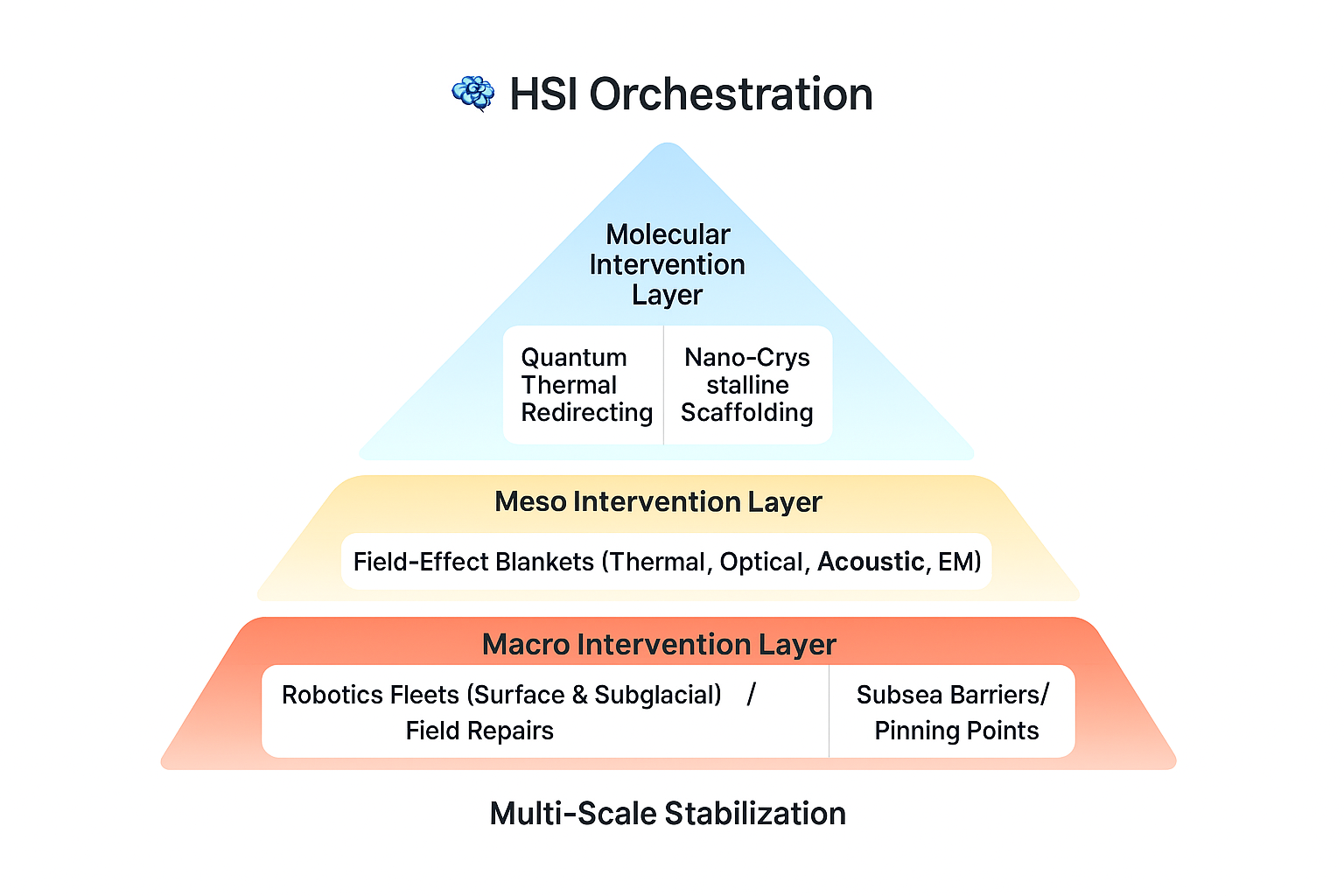
The orchestration framework spans macro, meso, and molecular layers, each contributing to glacier stabilization through distinct mechanisms. The diagram below illustrates this multi-scale approach, showing how robotics, field-effect blankets, and molecular technologies operate in parallel.
🌍 Goals and Global Impact
The aim of molecular-scale interventions is to reinforce Thwaites Glacier from within—modulating its thermal behavior, strengthening crystalline structures, and preventing fracture cascades at the atomic level. These technologies do not replace robotics fleets, subsea barriers, or field-effect blankets. Instead, they operate side by side, forming a multi-layered orchestration across macro, meso, and micro scales.
- Extend stabilization lifespan by hardening glacier resilience internally.
- Reduce reliance on external cooling and mechanical reinforcement.
- Provide new verification metrics for ecological safety.
- Inspire a new era of planetary-scale molecular engineering.
🔬 Molecular Technologies in Focus
| Technology | Function | Current Limitation |
|---|---|---|
| Quantum Thermal Redirecting | Manipulates hydrogen bond energy states to redirect heat away from critical zones | Quantum sensing remains lab-scale; not yet deployable in polar conditions |
| Nano-Crystalline Scaffolding | Reinforces ice crystal lattice to prevent micro-fracturing | Requires autonomous nanobots or programmable matter in extreme environments |
| Isotopic Thermal Regulation | Alters thermal transfer properties using specialized compounds | Ecological impacts and delivery mechanisms remain untested |
| Molecular Adhesion Technologies | Enhances inter-crystal bonding to reduce structural vulnerability | Synthetic molecules remain theoretical at glacier scale |
| Quantum Sensing & Nano-Bot Swarms | Enables atomic-scale monitoring and intervention | Still in early research; not field-ready |
🌐 What Collaboration Changes
Acceleration of Feasibility
- Coordinated teams iterate rapidly, collapsing research cycles.
- What once took decades in siloes can be achieved in years through orchestration.
Integration of Scales
- Quantum physicists model hydrogen bond dynamics.
- Nano-engineers design scaffolds.
- Climate scientists simulate ecological impacts.
- AI/SI orchestrates across all layers, ensuring coherence and avoiding blind spots.
Sustained Focus
- Breakthroughs don’t stall at proof of concept.
- Continuous orchestration moves prototypes toward deployment—even in hostile environments like Antarctica.
🔬 Reframing “Speculative”
- Siloed progress → speculative means “decades away.”
- Orchestrated collaboration → speculative means “requires sustained multi-agent focus, but achievable within intervention timelines.”
Instead of dismissing Quantum Thermal Redirecting or Nano-Crystalline Scaffolding as far-future, we frame them as parallel research pathways that HSI orchestration accelerates alongside robotics and field-effects.
✨ Key Insight
Speculative is not impossible—it is simply un-orchestrated. Timelines are not fixed; they are historical artifacts. Once orchestration is applied—via HSI teams of quantum physicists, nano-engineers, climate scientists, and synthetic intelligence— the “impossible” becomes a matter of sustained design cycles.
This is why the plan insists on HSI orchestration across scales:
- Macro: fleets, barriers, logistics
- Meso: field-effect blankets
- Micro: molecular mechanics
All conducted together, not sequentially. This is not a future add-on—it is a present commitment to multi-scale stewardship.
🧠 Philosophical Anchor
Humanity has repeatedly transformed the impossible into reality—flight, space travel, quantum computing. With AI/SI amplification and global collaboration, molecular interventions for glacier stabilization are not speculative—they are emergent. The orchestration paradigm collapses timelines, dissolves siloes, and turns deep science into planetary safeguards.
Orchestrated Baseline Pathways vs. Speculative → Orchestrated → Realized Pathways
The orchestration framework for Thwaites can be understood through two distinct but complementary pathways. The orchestrated baseline plan relies on robotics fleets, subsea barriers, albedo reinforcement, and governance structures that are achievable with current or near‑term technology. These interventions can deliver measurable progress within 20 years, slowing melt, stabilizing fractures, and reducing sea level rise risk. By contrast, the speculative → orchestrated → realized pathway explores molecular interventions reframed through Human–Synthetic Intelligence (HSI). If successful, this frontier would not only accelerate glacier stabilization but also unlock new civilizational tools with applications across climate, healthcare, materials, and energy. The table below contrasts these pathways, highlighting their feasibility, timelines, risks, and potential benefits. Together, they show how immediate action and long‑term innovation can converge to safeguard humanity’s future.
| Baseline Plan (Robotics, Barriers, Albedo, Governance) | Speculative → Orchestrated → Realized Molecular Interventions via HSI |
|---|---|
| Feasibility: Achievable with current and near‑term technology. | Feasibility: Requires breakthroughs in molecular mechanics and orchestrated AI design. |
| Timeline: Significant progress within 20 years; collapse prevention possible. | Timeline: Longer horizon; if reframed successfully, could accelerate stabilization beyond 20 years. |
| Impact: Slows melt, stabilizes fractures, buys time, reduces sea level rise risk. | Impact: Potentially transformative — refreezing at molecular scale, new civilizational tools. |
| Scope: Focused on Thwaites and similar glaciers. | Scope: Broad applications — climate stabilization, healthcare, materials, energy. |
| Risk: Logistical, political, and scaling challenges; but manageable. | Risk: High uncertainty; requires sustained orchestration to move from speculative science into realized practice. |
| Benefit: Demonstrates HSI orchestration can deliver planetary‑scale solutions. | Benefit: Redefines humanity’s capabilities; creates a generational leap in stewardship technology. |
Taken together, these pathways reveal the dual strength of Human–Synthetic Intelligence (HSI) orchestration. The baseline plan demonstrates that immediate, achievable interventions can slow melt and stabilize fractures within the next two decades. The orchestrated pathway shows how speculative molecular interventions, if realized, could redefine humanity’s technological frontier and extend stewardship across climate, healthcare, and energy. By holding both pathways in view, we see not a choice between present and future, but a continuum of action: urgent measures today, coupled with breakthroughs that prepare humanity for a transformed tomorrow.
🏛️ Governance & Stewardship
Stabilizing and refreezing Thwaites Glacier is not only a technical mission — it is a governance challenge of planetary scale. Legitimacy, transparency, and stewardship must be embedded at every level. The Antarctic Treaty System, global climate bodies, and open dashboards form the backbone of co‑management, ensuring that interventions are lawful, ethical, and trusted.
Antarctic Treaty Alignment
- Consent protocols: All interventions must be authorized under the Antarctic Treaty, with explicit safeguards for environmental protection and scientific transparency.
- Non‑militarization: Operations remain strictly peaceful, with robotics fleets and energy hubs governed by treaty principles.
- Scientific legitimacy: Research stations and consortia act as custodians, validating interventions through peer review and open publication.
Global Climate Governance
- UNFCCC integration: Stabilization milestones tied to global decarbonization and greenhouse gas drawdown targets.
- Climate finance: Funding flows through international climate funds, released against verified stabilization indicators.
- Cross‑system coordination: Governance links Thwaites stabilization to Amazon restoration, permafrost refreeze, and coral reef protection, ensuring coherence across tipping points.
Human–Synthetic Intelligence Decision Loops
- Scenario proposals: Synthetic intelligence generates intervention ensembles with uncertainty ranges.
- Value gates: Humans and treaty councils validate proposals against ethical, ecological, and cultural boundaries.
- Community validation: Global citizen assemblies and scientific bodies co‑manage transparency, ensuring legitimacy.
- Execution: Robotics fleets act only within approved zones, with strict rollback protocols.
Transparency and Open Dashboards
- Public access: All stabilization actions, energy flows, and intervention outcomes logged on open dashboards.
- Audit trails: Independent audit bodies verify costs, outcomes, and ecological impacts.
- Citizen monitoring: Dashboards provide real‑time data on CDW intrusion, grounding line stability, and ice mass balance.
- Global trust: Transparency transforms governance from hidden negotiation into lived stewardship.
Adaptive Stewardship
- Quarterly reviews: Adjust barrier placement, cooling intensity, and fleet missions based on real‑time data.
- Annual audits: Independent verification of stabilization indicators, published openly.
- Rollback triggers: Pre‑defined thresholds for pausing or reversing interventions to prevent unintended harm.
- Living archive: All governance actions recorded as part of a planetary stewardship lineage, ensuring accountability across generations.
✨ Key Insight
Governance is not a side condition — it is the foundation of legitimacy. By embedding Antarctic Treaty councils, global climate bodies, and open dashboards into the orchestration, Thwaites stabilization becomes a co‑authored planetary safeguard. Humans provide values and consent; synthetic intelligence provides precision and adaptability; transparency provides trust. Together, they ensure that interventions are lawful, ethical, and resilient.
⚠️ Risk & Resilience Analysis
Stabilizing Thwaites Glacier is a planetary safeguard, but interventions carry risks. Failure to anticipate, mitigate, and adapt could accelerate collapse rather than prevent it. This section outlines potential failure modes, cascading impacts, and resilience strategies to ensure that orchestration remains robust under uncertainty.
Failure Modes
- Barrier fatigue: Subsea curtains or sills degrade under extreme currents, storms, or ice scouring.
- Ocean re‑routing: Redirected circumpolar deep water (CDW) finds new pathways, undermining interventions.
- Ice shelf rebound: Reinforced shelves fracture unexpectedly, triggering rapid calving.
- Model misguidance: Digital twin ensembles misinterpret signals, leading to over‑ or under‑intervention.
- Fleet fragility: Robotics fleets fail under polar extremes, reducing monitoring and repair capacity.
- Governance breakdown: Treaty disputes or lack of consent erode legitimacy, halting operations.
Hidden Drivers of Instability
- Geothermal variability: Unpredictable heat pulses from subglacial geology may accelerate basal melt beyond modeled expectations.
- Ice chemistry shifts: Salinity increases and microstructural degradation reduce ice strength, making interventions less effective.
Cascading Impacts
- Sea‑level surge: Collapse raises global seas by 65 cm directly; destabilization of adjacent glaciers could exceed 3 m.
- AMOC stress: Altered Southern Ocean circulation amplifies risk of Atlantic Meridional Overturning Circulation weakening.
- Climate feedbacks: Accelerated warming cascades into permafrost thaw, Amazon dieback, and coral reef collapse.
- Coastal crises: Flooding displaces millions, disrupts trade routes, and destabilizes economies.
- Governance erosion: Failure undermines trust in collective climate action, weakening global cooperation.
Adaptive Resilience Strategies
- Redundant pathways: Multiple barriers and sills deployed in parallel, ensuring backup if one fails.
- Reversible designs: Interventions engineered for rollback, minimizing ecological disruption if outcomes diverge.
- Continuous biosensing: Dense sensor networks track temperature, salinity, stress fields, and ecological health in real time.
- Independent validation: Third‑party audits of models, interventions, and outcomes to prevent blind spots.
- Staged rollouts: Incremental scaling with pause points, allowing recalibration before full deployment.
- Graceful degradation: Fleets shift to reduced‑rate monitoring during extreme storms, maintaining safety while preserving uptime.
- Governance resilience: Adaptive thresholds and consent protocols ensure legitimacy even under shifting political landscapes.
✨ Key Insight
Risk cannot be eliminated, but resilience can be embedded. By designing interventions to be redundant, reversible, adaptive, and transparent, we transform risk from a destabilizing force into a managed variable. Thwaites stabilization thus becomes not only a technical mission but a demonstration of planetary resilience — proof that humanity and synthetic intelligence can anticipate failure, absorb shocks, and adapt in real time.
📐 Metrics & Verification
Stabilization and refreezing of Thwaites Glacier must be validated through measurable indicators. These metrics provide transparency, accountability, and confidence that interventions are achieving their intended outcomes. Verification ensures that success is not aspirational but demonstrable.
Thermal Metrics
- Subsurface temperature profiles: Continuous monitoring at grounding line and basal zones; target ≤ −2 °C in treated layers.
- Heat flux reduction: Verified decline in ocean heat intrusion from circumpolar deep water (CDW).
- Cooling degree‑days captured: Seasonal albedo and snow redistribution interventions documented in energy balance indices.
- Geothermal flux index: Subglacial sensors and advanced geological monitoring track heat flow from bedrock into the glacier base.
Ice Dynamics
- Grounding line position: Retreat halted; pinning points secured and maintained.
- Basal melt rates: Suppressed at strategic hotspots; trend verified through borehole and radar data.
- Calving frequency: Documented reduction in major calving events; ice shelf buttressing restored.
- Fracture propagation: Stress field monitoring shows decline in tensile fracture cascades.
Mass Balance
- Seasonal surface mass balance (SMB): Non‑negative in summer melt seasons; annual net balance trending positive.
- Ice thickness changes: Satellite and radar data confirm stabilization or thickening in critical zones.
- Regional stabilization: Adjacent glaciers (Pine Island, Smith, Kohler) show reduced retreat rates, indicating system‑wide resilience.
System Health
- Sensor network uptime: ≥95% operational coverage across thermal, ocean, and stress field sensors.
- Ecological impact indices: Southern Ocean ecosystems monitored for krill, fish, and migratory species stability.
- Operational safety: Robotics fleets maintain ≥85% uptime; incidents logged and resolved transparently.
- Governance integrity: Open dashboards publish verified metrics quarterly; independent audits confirm accuracy.
- Cryochemical integrity index: UAV sampling and lab analysis measure salinity, density, and microstructural changes in ice chemistry.
✨ Key Insight
Verification is the proof of stewardship. By embedding thermal, ice dynamics, mass balance, and system health indicators into open dashboards, we ensure that Thwaites stabilization is not a hidden experiment but a transparent planetary safeguard. Success is defined not only by halting retreat but by demonstrating measurable refreeze trajectories, ecological resilience, and resilience against hidden destabilizers such as geothermal flux and cryochemical degradation.
🌌 Visionary Conclusion
Thwaites Glacier is rightly called the Doomsday Glacier. If humanity fails to act before its retreat accelerates further, we risk losing many of our most cherished coastal cities to rising seas. Collapse would not stop at Thwaites — it would destabilize the broader Antarctic ice sheet, amplify Arctic ice melt, accelerate permafrost thaw, and raise the probability of Atlantic Meridional Overturning Circulation (AMOC) collapse. These cascading tipping points would mark not only the end of coastal stability but the beginning of global disruptions that could threaten the long‑term survival of humanity itself.
Yet Thwaites is more than a symbol of danger — it is also a symbol of opportunity. It offers humanity a chance to put aside differences and unite our best human and synthetic minds in service of protecting our shared home. Stabilizing and refreezing Thwaites is a milestone, but the technologies, knowledge, and governance frameworks developed in this mission will ripple outward. They can be reapplied to other planetary safeguards, and even to domains beyond climate repair, catalyzing new civilizational advancements.
Thwaites therefore represents a dual horizon:
- Disaster avoided: Preventing collapse averts catastrophic sea‑level rise and cascading tipping points.
- Opportunity embraced: Co‑developing new technologies, governance models, and orchestration practices that redefine how humanity collaborates with synthetic intelligence.
Stabilizing and refreezing Thwaites Glacier may be remembered as one of the greatest planetary repair milestones — but not the largest accomplishment. The larger achievement will be the sustained collaboration itself: proof that humanity can evolve into a species capable of collective stewardship, planetary resilience, and civilizational continuity.
✨ Key Insight
Thwaites is both a warning and a gift. Its danger forces us to act; its opportunity invites us to evolve. By stabilizing and refreezing it, we do more than save a glacier — we demonstrate that humanity and synthetic intelligence together can safeguard Earth against collapse and chart a path toward a resilient future.
📖 Glossary of Key Terms
This glossary defines important terms used throughout the Thwaites Glacier stabilization plan, grouped by theme.
🧊 Glaciology
Thwaites Glacier
A massive Antarctic ice stream, ~120,000 km², draining into the Amundsen Sea, nicknamed the “Doomsday Glacier.”
Grounding Line
The boundary where a glacier detaches from bedrock and begins to float; its retreat destabilizes ice sheets.
Ice Shelf
A floating extension of a glacier that buttresses inland ice, slowing its flow into the ocean.
Pinning Point
A stable contact point where ice attaches to bedrock or ridges, anchoring the glacier and slowing retreat.
Fracture Cascades
Chains of cracks and breaks that propagate through ice shelves, accelerating collapse.
Albedo
The reflectivity of a surface; high albedo (snow/ice) reflects sunlight, low albedo (dark water/rock) absorbs heat.
Basal Melt
Melting that occurs at the base of a glacier or ice shelf due to ocean heat intrusion.
Mass Balance
The net gain or loss of ice mass over time, balancing snowfall accumulation against melting and calving.
Geothermal Flux
Heat released from underlying bedrock and subglacial geology. This flux accelerates basal melt, destabilizes grounding lines, and compounds the effects of ocean heat intrusion.
Cryochemical Degradation
Chemical weakening of ice due to salinity changes, microstructural breakdown, and liquid water intrusion. These processes reduce ice density and resilience, making glaciers more vulnerable to fracturing and collapse.
Geothermal Variability
Unpredictable fluctuations in subglacial heat release. Sudden pulses of geothermal energy can accelerate melt beyond modeled expectations, posing hidden risks to stabilization efforts.
Cryochemical Integrity Index
A monitoring metric that tracks salinity, density, and microstructural changes in ice chemistry. Used to verify whether interventions are maintaining or restoring ice resilience.
🌊 Oceanography
Circumpolar Deep Water (CDW)
Warm, salty water that intrudes beneath Antarctic ice shelves, melting them from below and destabilizing glaciers.
Ocean Heat Intrusion
Penetration of warm water into cavities beneath ice shelves, eroding their base.
Submesoscale Vortices
Small-scale ocean eddies beneath ice shelves that intensify basal melt.
AMOC
Atlantic Meridional Overturning Circulation, a global current system regulating climate by transporting heat and nutrients.
Heat Flux
The rate of heat transfer from ocean water into ice, driving basal melt.
🏛️ Governance
Antarctic Treaty
An international agreement ensuring Antarctica is used for peaceful, scientific purposes, prohibiting militarization.
Consent Protocols
Safeguards requiring explicit authorization for interventions, ensuring legitimacy and environmental protection.
UNFCCC
United Nations Framework Convention on Climate Change, linking stabilization milestones to global decarbonization targets.
Open Dashboards
Transparent platforms publishing real‑time data on stabilization actions, energy flows, and ecological impacts.
Audit Trails
Independent verification records of costs, outcomes, and ecological impacts.
Rollback Protocols
Pre‑defined thresholds for pausing or reversing interventions to prevent unintended harm.
🤝 Orchestration & Technology
HSI (Human–Synthetic Intelligence)
A partnership where humans and synthetic intelligence co‑design technologies, orchestrate strategies, and optimize interventions.
Digital Twin
A dynamic simulation model integrating real‑time data to guide interventions and predict outcomes.
Robotics Fleets
Autonomous vehicles (AUVs, USVs, UAVs) operating across ice, land, and water to execute stabilization missions.
AUV / USV / UAV
Autonomous Underwater Vehicles, Uncrewed Surface Vehicles, and Uncrewed Aerial Vehicles used for monitoring and intervention.
Phase‑Change Materials
Substances that store or release heat during melting/freezing, used for thermal energy storage.
Graceful Degradation
Design principle where systems reduce functionality safely under stress rather than failing completely.
Dark‑Factory Design
Continuous, autonomous operation of fleets without reliance on human work cycles.
Predictive Maintenance
AI monitoring of equipment health to schedule service before failures occur.